


40th Anniversary
Tennis Seniors ACT celebrated its 40th birthday with a dinner on Friday 7 May at the Southern Cross Club West, Jamison. Around 75 present and past members and their partners attended the dinner to reminisce over the many achievements during this period. Click here for photos.
This was the first seniors/veterans organisations to be formed in Australia. Its first meeting was on 6 May 1970 at the Manuka Pavilion. Unfortunately a number of those at this meeting are no longer with us. The first President was Bob Thornton.
He remained President for the first seven years. As Pat Moloney, the current President, said in introducing Bob , “it is obvious these early years under Bob's presidency established the solid foundation which has enabled the continuance of seniors tennis in the ACT for the past 40 years and for its continuance into the future.”
Bob also referred to a number of the early issues which were covered in some of his early correspondence and reports - retaining the interest of older players, arresting the drift of senior players to other sports or early retirement and encouraging the younger seniors to assist in the promotion and administration of the seniors.
In one report Bob said – ”It is of great concern to the Senior Branch that the administration of tennis in the ACT is left so overwhelmingly to the “oldies”. The absence of players in the younger bracket coming through to share the work-load creates a disturbing situation and it is to be hoped that perhaps 1975 may see some new blood willing to do a job for ACT tennis.” As Pat said, “I think those comments are equally valid today, 40 years on”.
Anne then spoke about the members who were involved in the administration of Seniors at the ACT and Australian level, the organisation of ACT, Australian and World events and the players who had won titles at both the Australian and World level.
Their efforts have been rewarded in a number of ways. Ken Willis, Bob Hay, Alison Ide and Harry Gibbs received Australian Veteran of the Year Awards. Ros Balodis was awarded on three occasions the Australian Player of the Year. Anne received the Australian Administrator of the Year in 2001. Alison Ide was also made a Life Member of Tennis Seniors Australia.
The Frank Thornton Award for Veteran of the year was named after the first Treasurer (1970-1978). It was first awarded in 1981 to Charles Boag.
The George Henshilwood award for Administrator of the Year was first awarded in 1985 to Peter Breugelmans, the Treasurer since 1995. George produced Vetset for over 25 years.
Four members have been made Honorary Life Members over the years – Joan Hammond and Joan Willis in 1989, George Henshilwood in 1993 and Jean Boag in 1997. Jean Boag was Secretary from 1973-1979 and 1980-1986. Joan Willis was Treasurer from 1978-1987.
Over the 40 years the ACT veterans have punched well above their weight and it shows that although the ACT is small in size and numbers it is up with the major states in maintaining a high and reputable profile.
|
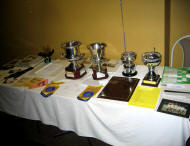 Memorabilia was on display at the dinner.
 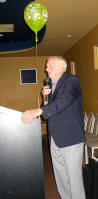 Bob entertained
the dinner with stories from the early days. The committee
needed funds. One idea was a bumper sticker. Bob suggested
‘Want a 40 lover – play Vets tennis’. However the committee
at the time thought it was a bit risqué and changed it to
'Be a 40 lover, play Vets tennis’. One of our older
members is still driving around displaying the sticker.
Bob entertained
the dinner with stories from the early days. The committee
needed funds. One idea was a bumper sticker. Bob suggested
‘Want a 40 lover – play Vets tennis’. However the committee
at the time thought it was a bit risqué and changed it to
'Be a 40 lover, play Vets tennis’. One of our older
members is still driving around displaying the sticker.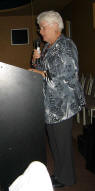 Anne Haycock,
the longest serving President (from 1991-1999), then touched
on those who had made a difference to the organisation. It
was a long list and as Anne said at the start “The short
answer is everyone – because we all know if we don’t have
the also-rans we don’t have an event”.
Anne Haycock,
the longest serving President (from 1991-1999), then touched
on those who had made a difference to the organisation. It
was a long list and as Anne said at the start “The short
answer is everyone – because we all know if we don’t have
the also-rans we don’t have an event”.
